

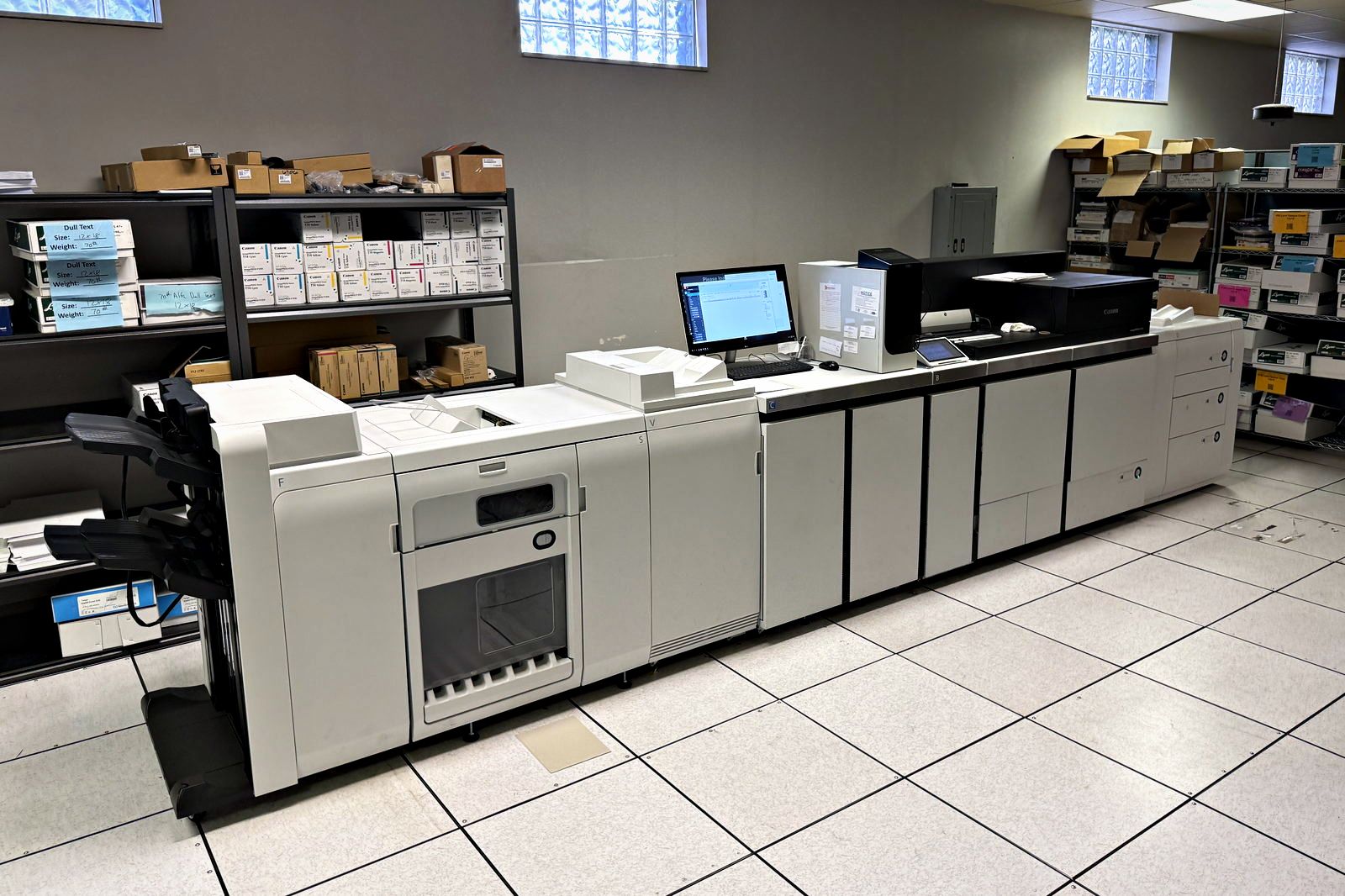
Canon imagePRESS V1350 · Ricoh Pro C9500
Digital Printing in Pittsburgh
Short runs, versioned work and print on demand, at a quality that stands next to offset. No plates, no minimum that exists only to make the setup worthwhile.
What digital is for
When not having plates is the point
An offset press earns its keep by spreading a fixed setup across a long run. Digital has no plates to make, so that trade disappears — which makes it the right press for shorter quantities, for jobs with many versions, and for anything you would rather reprint on demand than store on a pallet.
It is also the only sensible answer when every piece has to be different. Merge names, offers, images or QR codes from a spreadsheet and the press does not care that no two sheets match — see variable data printing.
For long runs, oversized sheets or in-line coating, our offset presses will usually be better value, and we will tell you when that is the case.
Short runs
No plates, so the setup that makes offset efficient over a long run is simply absent. Print what you need rather than what makes the economics work.
Versions and personalisation
Every sheet can differ. Names, offers, images, QR codes and PURLs, driven from a spreadsheet - see variable data printing.
Print on demand
Reprint from the same file when stock runs low rather than warehousing a year of inventory that may go out of date before it goes out of the door.
A proof on the real paper
We can proof on the actual stock the job will run on, using the press that will print it - so the proof is not an approximation of the finished piece, it is the finished piece.
Full-colour envelopes
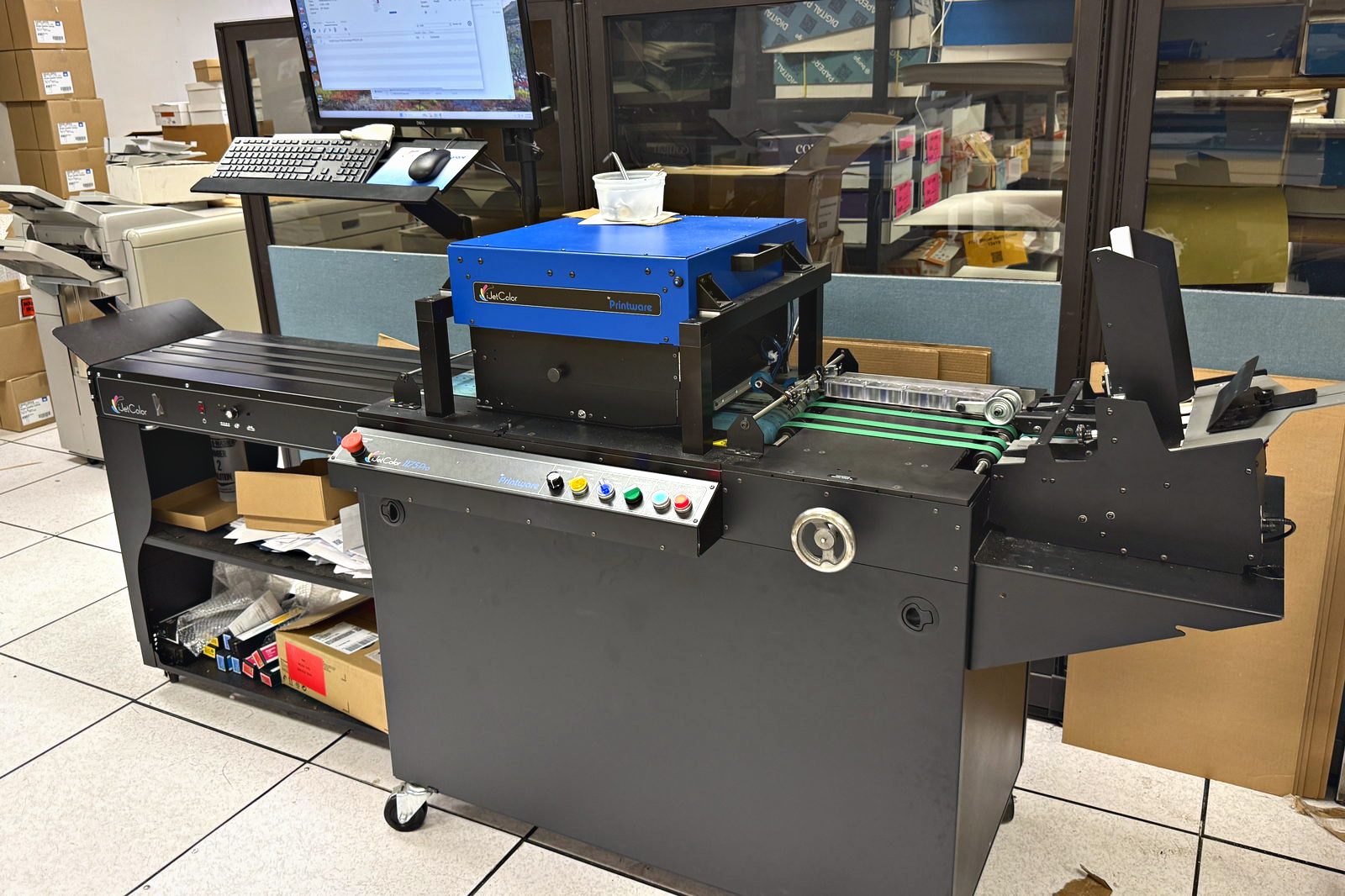
Our iJetColor 1175 Pro prints envelopes in full colour in house, so the outer piece is never the thing holding a mailing up.
Where the line falls
When digital stops being the cheaper answer
The usual answer is a round number — digital below five hundred, offset above it. We went and looked at ours instead. Across every job we costed since January 2023, the quantity where offset takes over moves by a factor of five, and what moves it is not the count. It is the shape. A folded piece reaches offset about ten times sooner than a flat one, and a bound piece never really starts on digital at all.
| Shape of the job | Digital holds until | What we actually see |
|---|---|---|
| Flat work, 1 to 2 pagesPostcards, sell sheets, rack cards | About 10,000 | Even between 5,000 and 10,000, only about a quarter of this work goes offset. |
| Folded work, 3 to 8 pagesBrochures, gate folds, self-mailers | About 1,000 | Between 1,000 and 2,500 it is genuinely an even split. Past 2,500 it is offset. |
| Bound work, 9 pages and upBooklets, catalogues, magazines | It does not | Above roughly 500 we run this offset almost without exception. |
Finished size can override all of it. Past about 19″ a sheet is bigger than either digital press can take, so the job goes on a 40″ press whatever the quantity. We run oversized work offset at a few hundred pieces as readily as at thirty thousand.
Stock, turnaround and how hard the colour has to work pull at it as well, which is why we would rather cost your actual job than hand you a rule that fits it badly. The offset page covers what the 40″ presses are for.
The presses
Two production presses, photographed on our floor
Canon imagePRESS V1350
- Speed
- 135 ppm
- Resolution
- 2400 × 2400 dpi
- Stock
- up to 400 gsm
Consistently Vivid toner, and registration that holds on duplex work - which is what matters when a job is going on to be folded and trimmed.
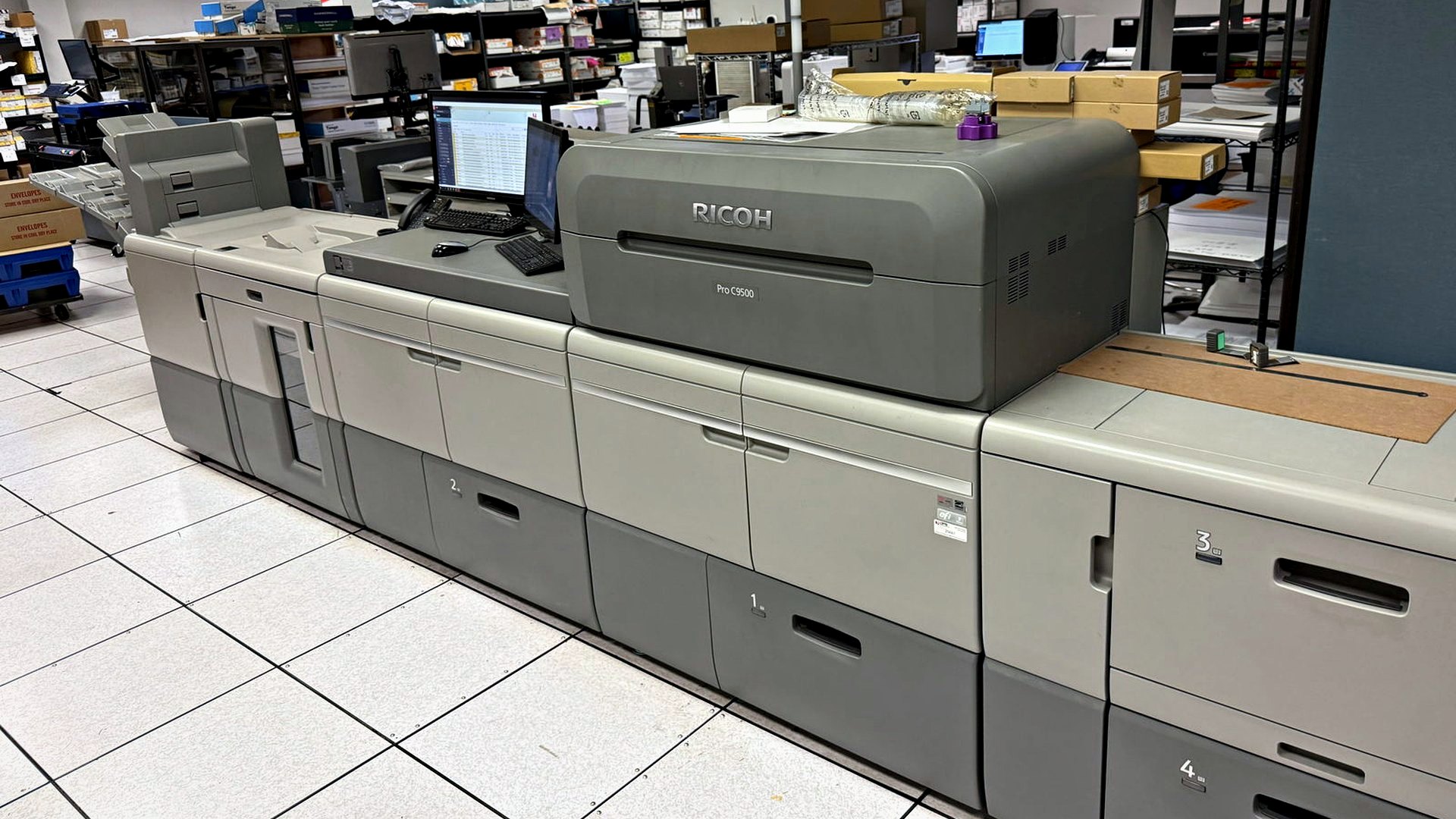
Ricoh Pro C9500
- Speed
- 115 ppm
- Resolution
- 2400 × 4800 dpi
- Stock
- up to 470 gsm
Will take a 13″ × 27.5″ sheet, so a three-panel roll fold can stay one piece. It costs more per sheet than the standard size and the quality is a step behind it, so it is worth having rather than worth defaulting to.
Where digital runs out
The sheet decides more than the quantity
A digital press prints a 13″ × 19″ sheet. That covers most of what gets asked for — letterheads, postcards, an A4 brochure, a stitched booklet — but it is a hard edge rather than a guideline. The sheet either fits or it does not.
The Ricoh will take a longer sheet, 13″ × 27.5″, which is how a three-panel roll fold stays a single piece instead of becoming two. We are glad to have it, and we will tell you what it costs: more per sheet than the standard size, and a quality step behind it. If a job can live on 13 × 19, it should.
Past that there is no digital option to weigh. Anything larger goes on a 40″ press, which takes a sheet up to 28″ × 40″, and that is the whole reason an oversized piece comes to us offset at three hundred copies as readily as at thirty thousand. The quantity never enters into it.
If a job has to have the Pantone ink, it has to be offset. A digital press has four toners and builds everything from them, so a PMS colour is always a process build rather than the ink itself.
That is a narrower limit than it sounds, though, because on a great many colours the build comes very close. And you do not have to decide on the strength of that sentence. We will put the process build on a digital proof — on the stock the job will actually run on, from the press that will actually print it — and you can look at it against the swatch before anything is committed. That is not a proof that suggests the finished piece. It is the finished piece. If it is acceptable — and often it is — the job stays digital and keeps the turnaround and the economics that come with it. If it is not, we move it to offset and print the actual ink. Either way it is your call, made from a printed sheet rather than from a conversation about what is possible.
Two related limits sit alongside it. Really tight registration, where the tolerance has to be held rather than hoped for. And colour consistency, which is the one people underestimate: holding a colour from the first sheet to the last, and matching it again on the reprint you order four months later. If a job turns on any of these, we would rather say so at the quote than at the press check.
There is a difference you can see, too, and it shows most on uncoated stock. Toner sits up on the surface of the sheet, so it carries a slight shine. Offset ink soaks into the sheet, which is why the same design printed litho looks noticeably flatter and more matte. Neither is wrong. But if you have set your heart on that soft, dead-flat look on an uncoated text stock, toner will not give it to you, and it is better to know that before the proof.
It runs the other way on synthetics. Toner adheres well to them and there is almost no waste getting up to colour, while offset ink can struggle to key to a synthetic stock at all and may take a long time to dry. For a waterproof tag, a membership card or anything destined to be handled outdoors, digital is not the compromise — it is the sound choice.
Which is the honest summary: inside a quick turn, a smaller quantity and a smaller sheet, digital is the better tool rather than a lesser one. Outside those, and on the three things above, it is the wrong one.
Turnaround
How long digital work actually takes
A proof comes back in one to two working days. From approval, most digital jobs are finished in three to five working days — no plates to make is a real part of why. Every figure on this page is working days; we do not count weekends into a schedule we have given you.
Some things genuinely add time, and it is better to hear it now than on the day it ships. Mailing, perfect binding, foil stamping, spot UV, die-cutting and laminating each add a step, and a special-order stock has to arrive before any of it starts.
None of that is a reason to assume a tight date cannot be met. Aggressive schedules are mostly a planning problem, and we are good at them — tell us the date you are working to at the start and we will build the schedule backwards from it.
Minimums
There is no minimum, and that is not the whole answer
We will print twenty-five of something if twenty-five is what you need. There is no floor, and no quantity below which we stop returning calls.
What is worth knowing is how the price behaves down there. Setting a job up — the file, the proof, the press, the cutting — costs much the same whether it is fifty pieces or five hundred, so at the bottom of the range that setup is most of what you are paying for and the per-piece price looks steep. It is not a penalty for ordering small. It is arithmetic, and it flattens out quickly as the quantity climbs.
The practical move, if the number is small and flexible, is to ask what the next quantity up costs. Often it is barely more in total, because the setup is already paid for.
Real jobs
Short-run work we have printed
Specifications as they actually ran.
Beacon College, Summer for Success Booklet
- 8pp + self cover, saddle stitched
- Printed on 100lb Gloss Cover
- Final size 8.5″ × 11″
Associated Artists Catalog
- 88pg + 4pg cover
- Soft Touch laminate
- Printed on 80lb Satin Cover
- Final size 5.2″ × 6.5″
Baptist Homes Foundation Pocket Folder
- 6pg pocket folder, custom wave pockets
- Die cut
- Printed on 120lb Silk Cover
Finishing
The same bindery either way
A digital job is not a lesser job here. It goes to the same bindery as everything off the Heidelbergs — saddle stitching, perfect binding, die cutting on the Bobst, folding, scoring, drilling, foil and lamination including Soft Touch.
And it can go straight into the mailing department afterwards: addressed, inserted, tabbed and delivered to the post office without leaving the building. That is usually the part that saves the most days.
Send us the job and we will tell you which press it wants
Quantity, versions, finished size and what the finish has to do — that is usually enough for us to say whether it is offset, digital, or one of each.
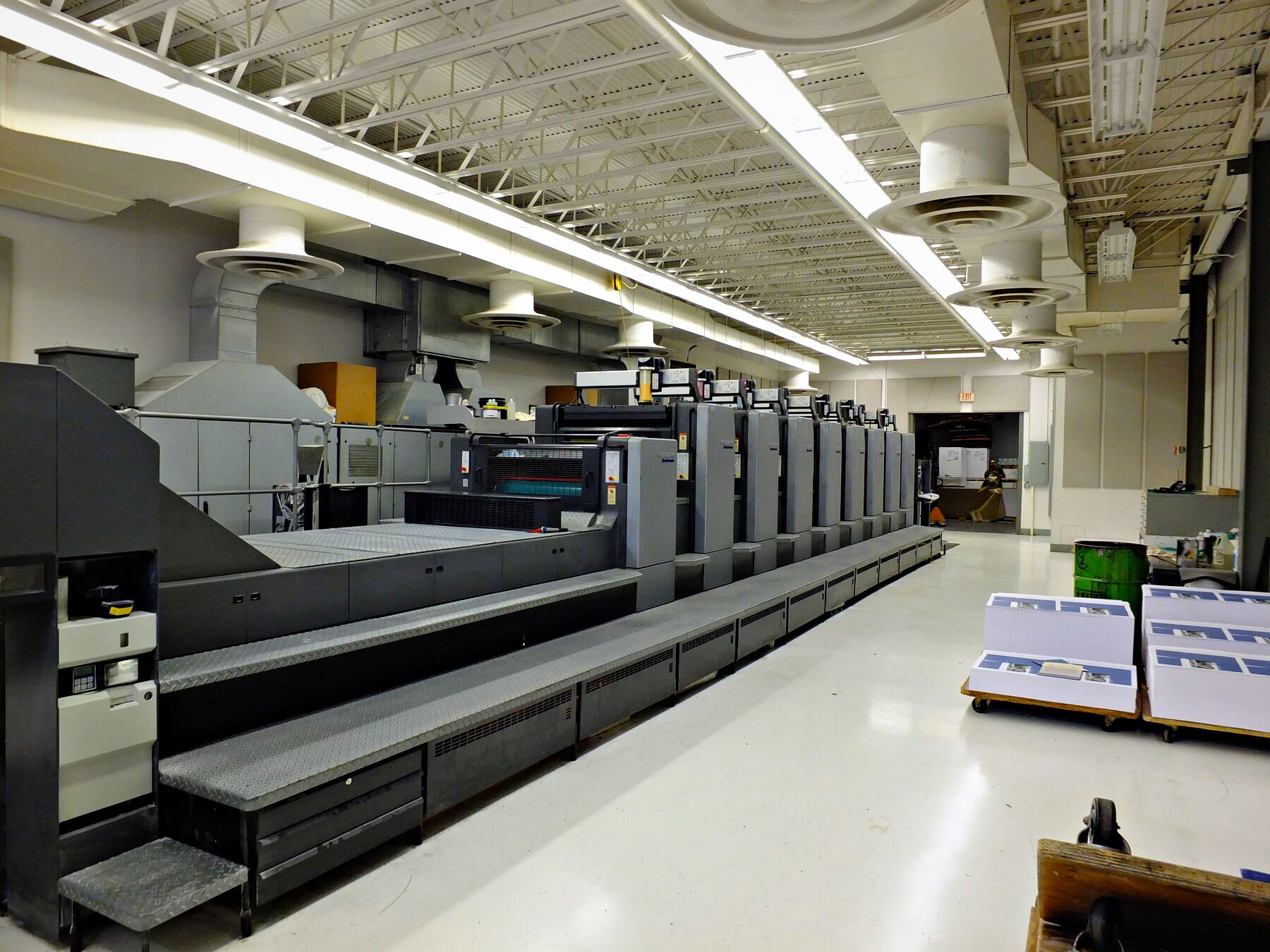
Vision for Print, Mail & Fulfillment in Pittsburgh
From Concept To Mailbox, We Do It All. Let Broudy Be Your Partner.
or call 412.362.6700