
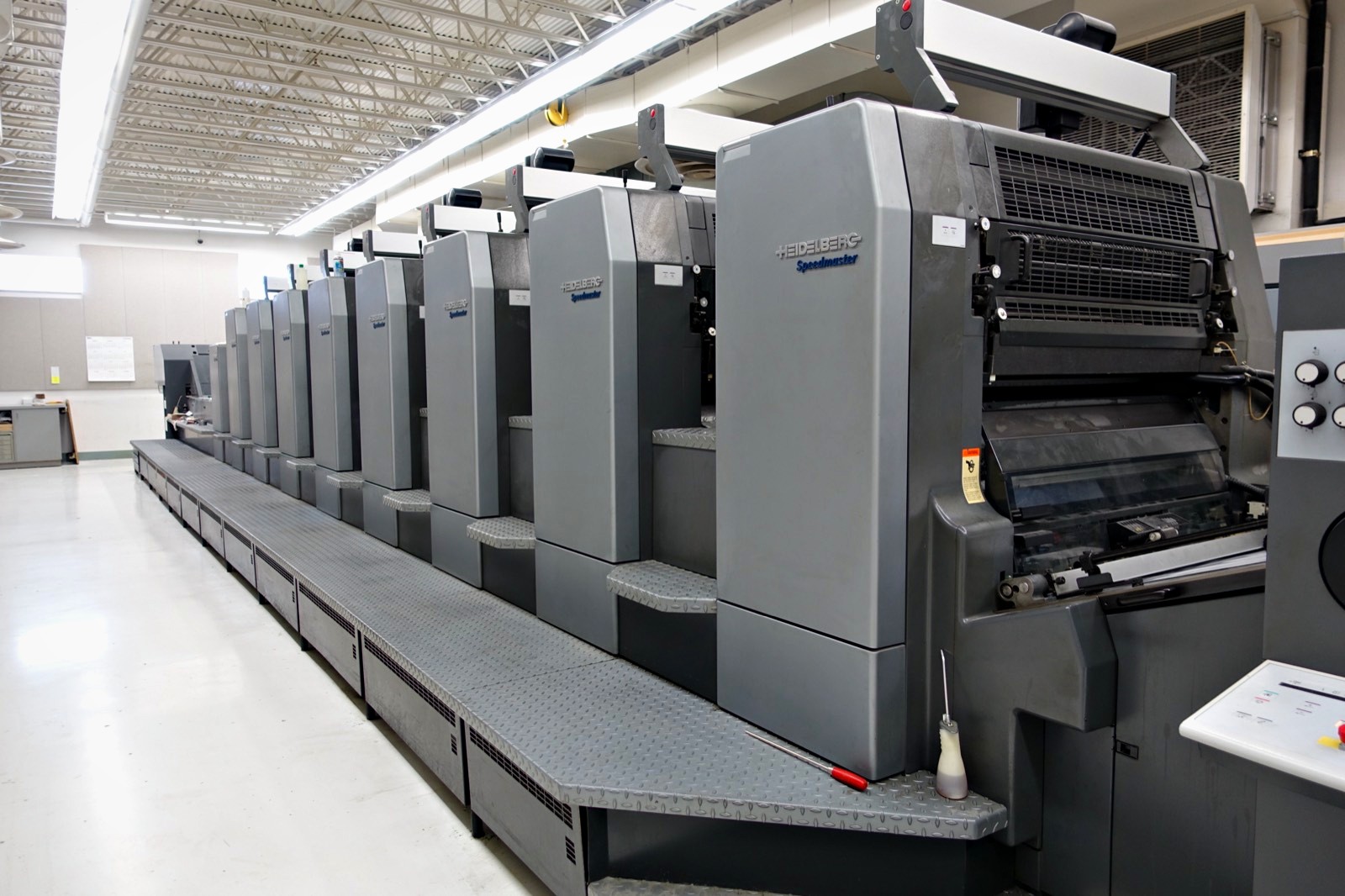
Heidelberg presses at 221 Auburn Street
Offset Printing in Pittsburgh
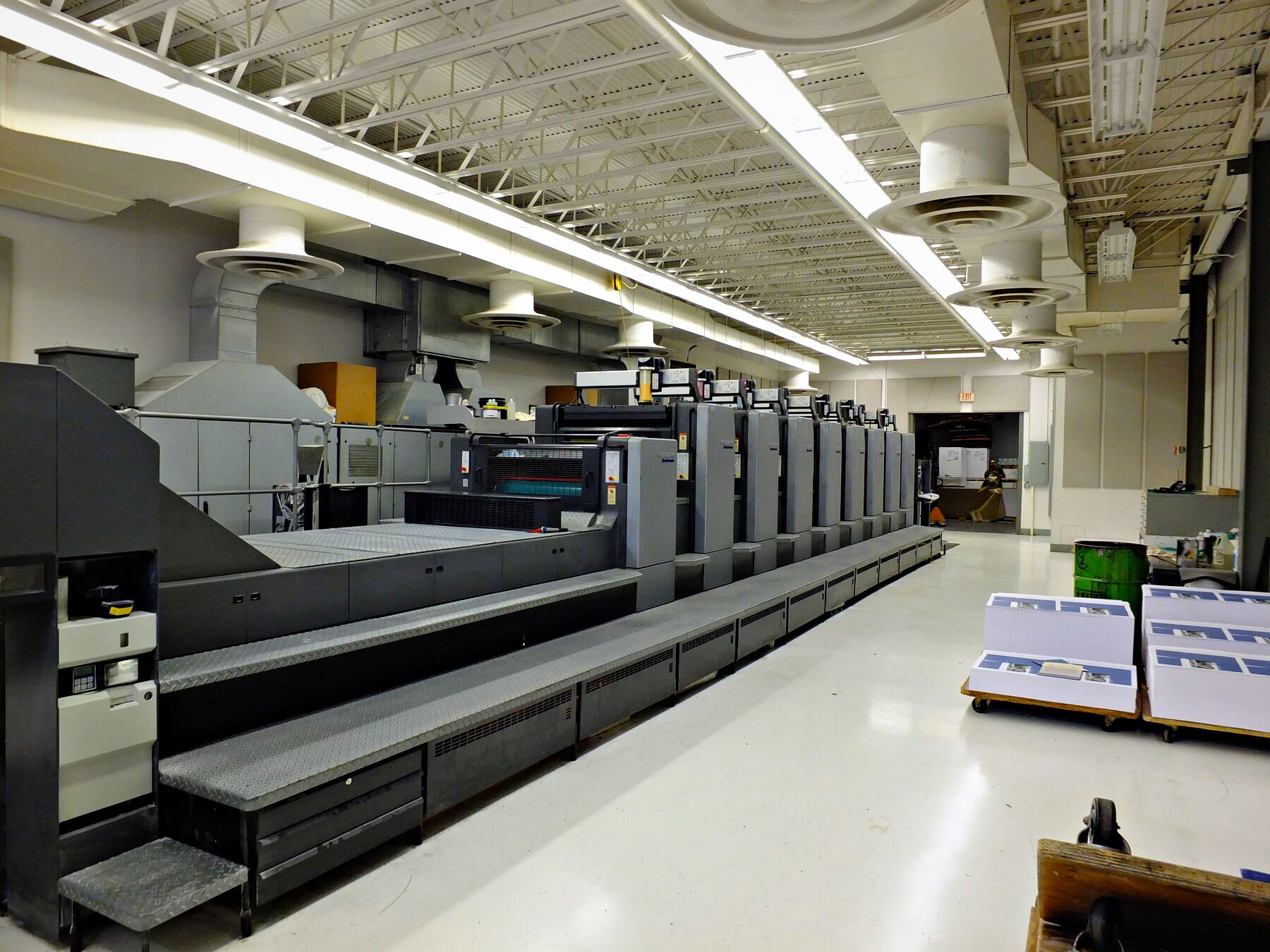
Two 40-inch sheetfed presses running six and eight colours plus coating, on our own floor in East Liberty. The kind of work that wants a big sheet, an exact colour and a proper finish.
What offset is for
When it is worth putting a job on a big press
Offset earns its place on work where the sheet is large, the colour has to be exact, or the finish is part of the message. A 28″ × 40″ sheet carries more pages per pass, which keeps longer runs efficient. In-line coating means the varnish or Soft Touch goes on while the sheet is still moving, rather than as a second operation somewhere else.
It is also the press to reach for when a brand colour has to be that colour rather than something close to it — which is a section of its own further down, because it is the thing that decides most jobs.
For shorter runs, versioned work or anything needing personalisation, our digital presses will usually be the better answer, and we will say so.
The presses
Two 40-inch Heidelbergs
Both take the same 28″ × 40″ sheet, so a job can go on whichever one fits it - the eight-colour when the work needs the extra units, the six when it does not and the schedule matters more.
Heidelberg Speedmaster CD 102
8 colour + aqueous coating tower
Autoplate, CP2000, infrared dryer, CIP3, Inkline and extended delivery. Takes stock up to 40 pt board, so it doubles as our packaging press.
Heidelberg Speedmaster CD 102
6 colour + aqueous coating tower
Six units plus coating means a fifth and sixth colour - a PMS match, a varnish - without a second pass.
What only offset does
Registration, exact colour, and holding it
PMS colour is the clearest case of all. A digital press has four toners and can only mix an approximation of a Pantone out of them. These presses run the actual ink — blended on site by Wikoff using EcoLogo certified inks, on a unit of its own. If a brand standard names a Pantone, this is the only way to print it rather than approach it.
Worth saying that this is not always a decision to take on trust. Digital gets very close on a lot of colours, and we are happy to show you a digital proof of the process build first, against the swatch. If it satisfies you, the job can stay on the smaller press with the turnaround that goes with it. We would rather you saw the difference than took our word for it.
Two more send a job here regardless of quantity. Tight registration, where the tolerance is small enough that it has to be held rather than hoped for. And colour consistency, which is the one people underestimate: holding a colour from the first sheet to the last, and matching it again on the reprint months later. Our presses are G7 Master Qualified, which is a measured standard for grey balance and tonality rather than an assurance about how careful we are.
There is also a difference you can see on uncoated stock. Offset ink soaks into the sheet, so the result is flat and matte. Toner sits up on the surface and carries a slight shine. If the design depends on that soft, dead-flat look on an uncoated text stock, this is the press that gives it to you.
The honest exception is synthetic stock. Offset ink can struggle to key to it and may take a long time to dry, whereas toner adheres well with almost no waste. For waterproof tags, cards and anything that lives outdoors, we will point you at digital instead — that is a case where the smaller press is simply the right one.
When it is worth the plates
The point where offset gets cheaper
Plates cost money before a single sheet prints, and then the price per piece stops moving. Everything below is about where that trade starts paying.
It is not one number. Looking at every job we costed since January 2023, a flat piece — a postcard, a sell sheet — stays cheaper digitally until around ten thousand. Fold it into a brochure and offset is already competitive near a thousand. Bind it, and above roughly five hundred we run it offset almost without exception, because the press is producing folded signatures rather than sheets somebody has to gather.
Size cuts across all of that, and it is the one place where there is nothing to weigh up. A digital press prints a 13″ × 19″ sheet, or 13″ × 27.5″ on the Ricoh at a higher cost and a small drop in quality. These presses take 28″ × 40″. If the piece does not fit the smaller sheet, offset is not the cheaper option — it is the only one, and that holds at three hundred copies as firmly as at thirty thousand.
The digital printing page sets the same figures out as a table, from the other direction.
Coating and finishing
Finished here, not sent out
Aqueous coating goes on in line — flood, spot or Soft Touch. Everything after that happens in the same building, which is usually where schedules are won or lost.
Die cutting
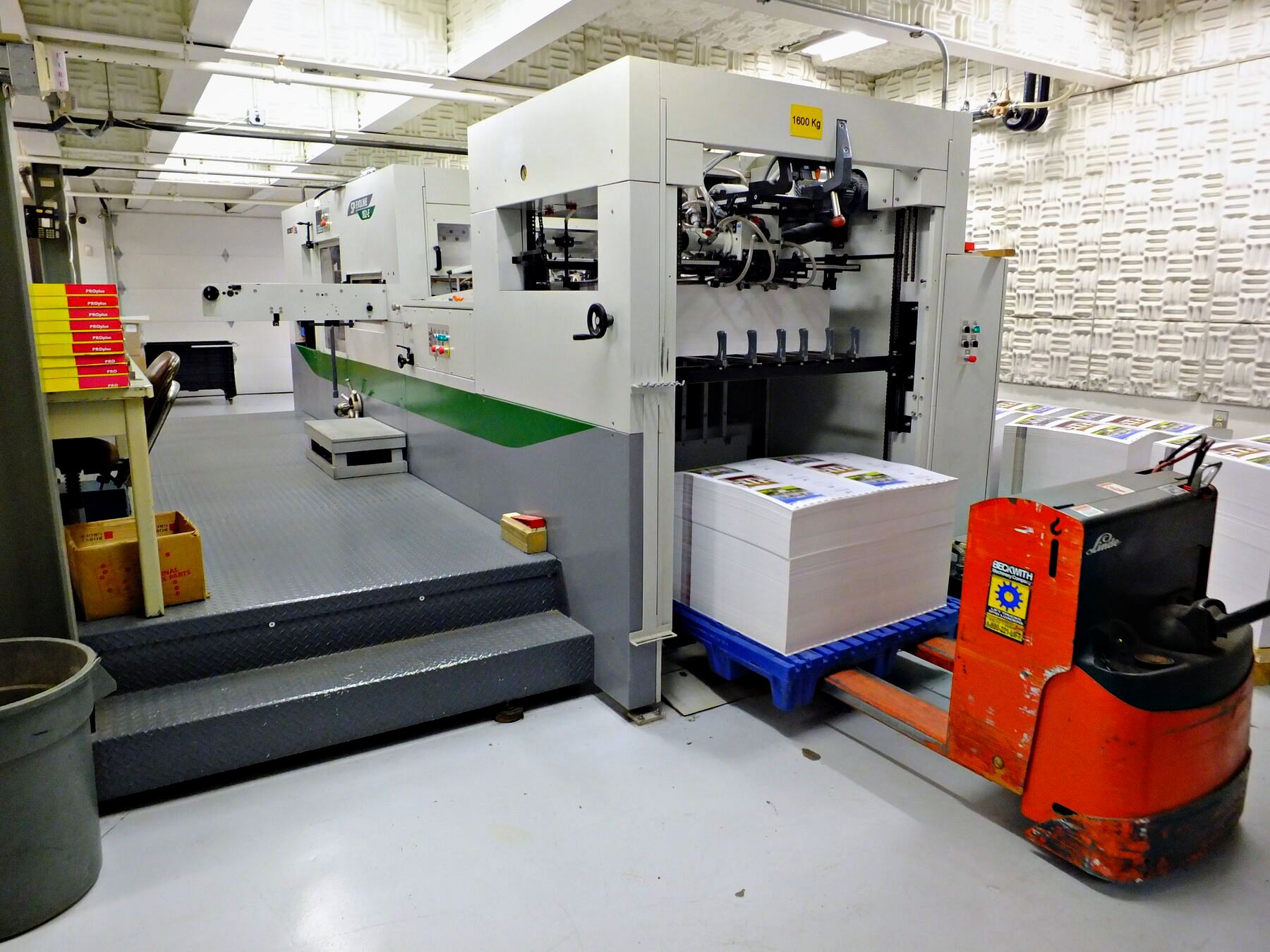
On a Bobst 102-E autoplaten, for pocket folders, custom shapes and anything that is not a rectangle.
Folding and scoring
Hinge scores on perfect-bound covers, gate and roll folds, and scoring heavy cover stock so it turns without cracking.
Saddle stitching
The most common binding in our portfolio by a distance, from 8-page self-covers up to 50-page books with inserts.
Perfect and case binding
For heavier page counts - the PPG trends book above runs 132 pages perfect bound.
Foil and laminate
Foil stamping and lamination, including Soft Touch, where a cover has to feel like something as well as look like it.
Drilling and perforating
Three-hole drilling for binder work, and perforations for reply cards and tear-offs.
Turnaround
What a schedule looks like
Proofs come back in one to two working days. From approval, most offset work is complete in five to seven working days — plates, make-ready and the press run itself account for the difference against digital.
Add time for anything that happens after the press: mailing, perfect binding, foil stamping, spot UV, die-cutting and laminating are each a separate pass. Special-order paper adds its own lead time, and it has to be here before the job can start, so it is the thing worth settling first.
That is the normal case, not the limit. Most aggressive deadlines are met by planning rather than luck — give us the date at the start, before stock is ordered, and it is usually achievable. Every figure here is working days, weekends excluded.
Real jobs
Printed on these presses
Specifications as they actually ran, not as a brochure describes them.
Carnegie Mellon University, College of Fine Arts Magazine
- 40 pages + 10 page insert + 4 page cover
- Saddle stitched with a No. 9 remittance envelope
- Text: 80lb McCoy Silk, 80lb Classic Techweave (Solar White)
- Cover: 100lb McCoy Silk with Soft Touch coating
PPG Architectural Finishes, 2020 Global Trends Book
- 132 pages + 4 page cover
- Perfect bound with hinge scoring
- Cover: 100lb PPG Gloss Cover
- Text: 100lb PPG Gloss Text
Centria Intercept Brochure
- 24 pages + cover
- Saddle stitched with 3-hole 5/16″ drilling
- Cover: 100lb Sterling Gloss Cover
- Text: 100lb Sterling Gloss Text
Paper
Stock we run every week
Across the jobs in our portfolio the recurring names are McCoy Silk and Matte, Sterling Gloss, PPG Gloss, Cougar Opaque and Endurance, in text and cover weights from 80lb upward — and, at the other end, board up to 40 pt on the eight-colour press.
We are FSC chain-of-custody certified, so a job that needs to carry the FSC mark can. If you have a house stock you already print on, we will quote it; if you want a recommendation, it helps to know how the piece will be used and whether it has to match something printed previously.
Not sure whether your job is offset or digital?
It usually comes down to how many you need, how many versions there are and what the finish has to do. Send us the job and we will tell you which press makes sense, and why — including when the answer is the cheaper one.
Vision for Print, Mail & Fulfillment in Pittsburgh
From Concept To Mailbox, We Do It All. Let Broudy Be Your Partner.
or call 412.362.6700